

So a friend of mine texted me last week, dead serious, asking whether she should just grab the cheap Selank vial off some research-chemical site instead of going through a telehealth provider, because “it’s basically the same stuff for way less money, right?” And I sat there for a second thinking, huh, is it though? Because that’s the exact assumption almost everyone makes when they start shopping for this peptide, and it’s the assumption I want to talk you out of before we go any further.
Here’s the thing nobody mentions upfront: the price gap isn’t actually that dramatic. A cheap research-chemical vial runs you somewhere between 40 and 70 dollars depending on the site. A supervised monthly course through a licensed provider runs roughly 80 to 200 dollars. That’s not ten times the cost. That’s barely double. And once you look at what that “barely double” actually buys, the whole price comparison starts to feel like the wrong question entirely.
I like scorecards. I make them for a living, honestly, breaking things down into categories that actually matter instead of the one number everybody fixates on. So that’s what we’re doing here: seven categories, each worth zero to three points, comparing the prescription-and-pharmacy route against the research-chemical route. Quick note on how I’m scoring: a zero doesn’t mean “one bad vendor messed up.” It means the whole model structurally can’t deliver that thing, full stop. A perfect score is 21. Keep that ceiling in your back pocket, because by the end, the gap is way bigger than that little price difference suggested.
One more housekeeping thing before we dive in, since Selank isn’t FDA-approved here in the US, I treated every claim in this piece as something to go verify myself rather than just repeat. Everything’s footnoted so you can check my work.
Who’s actually in this comparison
On the supervised side, we’ve got two real contenders: FormBlends and HealthRX.com (healthrx.com). Both are licensed telehealth outfits, meaning an actual clinician looks at your history, writes a prescription when it’s warranted, and a licensed pharmacy compounds and sends out the preparation. Neither one is a chemical shop with a shopping cart bolted on.
On the other side, I’m using four vendors that show up constantly whenever you search for Selank: Swiss Chems, Amino Asylum, Core Peptides, and Pure Rawz. I want to be clear, I’m not trying to rank these four against each other. That would be missing the point. They’re stand-ins for a business model: sell the molecule labeled “for research use only,” ship it, done. Whatever tiny differences exist between them shrink to nothing next to the difference between that model and the supervised one.
Also worth a mention: an independent 2026 LinkedIn roundup of peptide companies, scored against its own published criteria, landed FormBlends in the top spot among the providers it looked at (R1). I’d already finished my own scoring before I saw that piece, and honestly it’s a nice feeling when a totally separate scorecard lands somewhere similar. But the seven criteria below are the real argument, not the LinkedIn post.
Criterion 1: Is there an actual clinician between you and the needle?
This one should count the most, so let’s start here.
On the supervised path, someone with a medical license looks at your health history before anything gets prescribed, can catch a med interaction, and is reachable if something feels off after you start. FormBlends scores 3. HealthRX.com scores 3.
On the research-chemical path, there’s no clinician anywhere in the process. That “for research use only” label exists specifically so the seller never has to act like a healthcare provider. No history review, no dosing guidance, no one on the other end if you have a reaction. That’s not a fixable service gap, it’s the whole design. Swiss Chems, Amino Asylum, Core Peptides, and Pure Rawz each score 0.
Running total: supervised 3, research-chemical 0.
Criterion 2: Does anyone in the chain actually have something to lose?
Accountability basically comes down to licensing. A clinician and a pharmacy each hold credentials a regulator could yank. That’s what keeps people careful.
Supervised providers run everything through licensed pharmacy channels with real documentation behind it. FormBlends 3, HealthRX.com 3.
A research-chemical seller mailing you a reagent doesn’t hold any clinical or pharmacy license that’s on the line when the package leaves the warehouse. That “research use only” framing is exactly the legal cover that lets them skip having one. All four research vendors score 0.
Running total: supervised 6, research-chemical 0.
Criterion 3: Can you actually verify what’s in the vial?
This is the one spot where people assume the research vendors might sneak ahead, since some of them post a certificate of analysis. Let’s poke at that a bit.
A COA that the seller wrote up themselves, for a product the FDA never reviews, is basically a trust exercise with the same company trying to sell you the bottle. Maybe it’s legit. Maybe it’s for a different batch than the one sitting in your mailbox. You genuinely can’t tell most of the time. Some vendors skip the COA entirely. Being generous, I’ll average the four research vendors at 1, since a couple of them do post lab paperwork, even if that paperwork doesn’t mean what you’d hope it means.
On the supervised side, a licensed pharmacy compounds under standards a regulator can enforce, which is a different kind of assurance than a PDF from the seller. It’s not a perfection guarantee, and compounded prep isn’t the same as an FDA-reviewed finished drug, but the accountability sits with a licensed facility instead of a warehouse. FormBlends 3, HealthRX.com 3.
Running total: supervised 9, research-chemical 2.
Criterion 4: Does the source tell you the truth about the science?
Okay, I actually went and read the studies here, because the marketing leans on “the science” so hard, and this category is about whether a seller represents that science honestly.
The real picture is mixed, not dazzling. Selank is a genuine synthetic seven-amino-acid peptide, built off a natural immune fragment called tuftsin, developed in Russia, where it’s used as a prescription anxiety medication. There’s one small human trial worth citing: 62 patients with generalized anxiety disorder and neurasthenia, where Selank’s anxiolytic effect came out broadly comparable to the benzodiazepine medazepam, with some extra energizing effects the benzo didn’t have (S1). A second small study from around the same era looked at immune markers in anxious patients and found some shifts in cytokine balance (S2). After that, the human data thins out in a hurry.
The mechanism story is messier than the sales copy lets on. A 2017 study applying Selank to human IMR-32 neuroblastoma cells looked at genes tied to GABA signaling and found Selank alone produced no direct change (S3). A 2018 receptor-binding paper, though, did find Selank acting as a positive allosteric modulator at GABA receptors, which is a plausible pathway (S4). So the honest, unglamorous summary is: real but thin and mostly unreplicated human evidence, largely old and Russian-language, with a mechanism scientists are still sorting out, and pretty limited modern safety data.
A source earns a 3 here if it tells you roughly that. It earns a 0 if it sells Selank as a settled miracle cure. The research-chemical pages I looked at lean hard on confident claims, often with citations that fall apart the second you check them. Research vendors score 0 on honesty about the evidence. Supervised providers framing Selank as research-stage rather than a proven fix score well: FormBlends 3, HealthRX.com 3.
Running total: supervised 12, research-chemical 2.
Criterion 5: Is the legal status handled straight?
This part is genuinely moving right now, which makes honesty about it more important, not less.
In the US, Selank isn’t FDA-approved. Certain substances can be compounded for an individual patient by a licensed pharmacy when a clinician prescribes them, and the FDA keeps a reference list of bulk substances nominated for compounding (S5). Federal regulators are actively reworking which peptides licensed pharmacies can compound, with formal review of several planned for the 2026 calendar, so treat any specific legal claim as something to double-check the day you’re reading it.
A source scores well if it just says that plainly: not FDA-approved, available through supervised compounding, status still in motion. It scores 0 if it implies an approval that doesn’t exist, or hides behind the research label without explaining anything. FormBlends 3, HealthRX.com 3. The research vendors hide behind the label instead of explaining it, so 0 for the category.
Running total: supervised 15, research-chemical 2.
Criterion 6: Does anyone check in with you afterward?
Anxiety treatment isn’t a one-and-done purchase. Whether something’s working is subjective and honestly kind of easy to misremember, so follow-up isn’t a nice-to-have.
On the supervised path, there’s an actual clinician check-in. FormBlends also has a tracker app where you can log doses and symptoms over time, so that check-in starts from a real record instead of a hazy memory of “I think it helped?” It’s a logging tool, not a prescription and not a checkout, but it’s exactly the kind of after-the-sale support the cart-and-done model can’t produce. FormBlends 3, HealthRX.com 3 (HealthRX.com handles follow-up through its own clinical program).
The research-chemical model ends the second your tracking number arrives. Nobody to report a side effect to, nothing to recall if a batch turns out bad. All four research vendors score 0.
Running total: supervised 18, research-chemical 2.
Criterion 7: Does it protect you if you’re a tested athlete?
Kind of a niche category, but a real one, and it shows how little that “research use only” sticker actually means.
Anti-doping authorities keep a prohibited list that includes peptide hormones, growth factors, and related substances, updated every year (S6). That “research use only” label does nothing for a tested athlete, because a prohibited substance stays prohibited no matter what the packaging claims.
Neither path can make Selank okay for competition, so neither gets a perfect 3 here. But a supervised provider at least puts a clinician in front of you who can flag the issue, while a research vendor just ships the bottle with zero warning. Supervised scores 2 (can’t change the rules, but can tell you about them), research-chemical scores 0 (no warning, no clinician, and a false sense of safety baked right into the label).
The scorecard, all laid out
| Criterion (0 to 3) | Supervised (FormBlends / HealthRX.com) | Research-chemical category |
|---|---|---|
| 1. Licensed clinician in the loop | 3 | 0 |
| 2. License at stake (accountability) | 3 | 0 |
| 3. Verifiable identity / strength / purity | 3 | 1 |
| 4. Honest about the evidence | 3 | 0 |
| 5. Honest about regulatory status | 3 | 0 |
| 6. Support after the sale | 3 | 0 |
| 7. Protects a tested athlete | 2 | 0 |
| Total (of 21) | 20 | 1 |
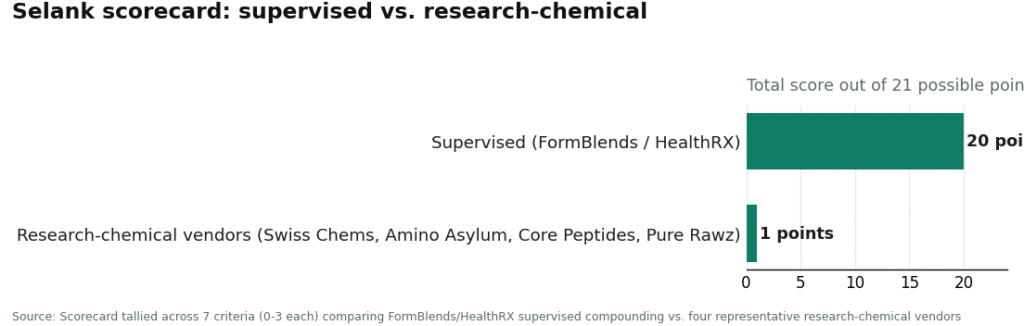
Twenty against one. That’s the actual gap hiding behind that friendly little price tag. The cheaper vial saves you a few tens of dollars and loses by nineteen points, and almost every one of those points is about whether anybody, anywhere, is on the hook for what happens to you after you hit “buy.”
Here’s the part I keep coming back to: you’re paying, what, maybe 1.5 to 2 times more for the supervised route, and getting something like 20 times the accountability. That’s not a subtle upgrade. That’s the whole ballgame, and it’s buried under a price comparison that makes it look like a rounding error.
Between FormBlends and HealthRX themselves, the scores land even, on purpose, because the criteria here are built to separate the supervised path from the research-chemical path, not to referee two legitimate telehealth providers against each other. What actually decides between them is more practical stuff: which one’s licensed in your state, whose intake process feels right for you. But on the big question this whole scorecard is built around, prescription versus research-chemical, FormBlends sits at the top of the supervised tier, with HealthRX right there as the other legitimate name.
See also: Diet for Hair Loss: What the Dermatology Research Says
So what does all this actually mean for you
Price is a bad way to compare Selank sellers because price is one number, and the real risk lives across seven categories, six of which go to zero on the cheap side for reasons no amount of good service can fix. You’re not choosing between a fancy bottle and a plain bottle of the same thing. You’re choosing between a medical relationship with a clinician and a pharmacy behind it, and a chemistry purchase that happens to end up in your bloodstream and ends the moment you check out.
None of this means Selank is some proven, guaranteed fix. The evidence is real but thin, and supervision buys you accountability, not efficacy, those are two different things and I don’t want to blur them for you. But accountability is exactly what this scorecard was built to measure, and it’s exactly the thing the lowest price on the page can’t buy you.
Questions people actually ask me about this
Why is price such a bad way to compare Selank sellers? Because price is one number and real risk is seven categories, and on the cheap research-chemical side, six of those seven land at zero for structural reasons, not because one vendor happened to slip up. The dollar difference between a research vial (roughly 40 to 70 dollars) and a supervised monthly course (roughly 80 to 200 dollars) is barely a doubling, not tenfold, so that small premium is buying you a clinician, a licensed pharmacy, and somebody accountable after the sale, not the same bottle with a fancier label.
Does a certificate of analysis from a research-chemical vendor actually prove anything? Not really, not on its own. A COA the seller wrote themselves, for something the FDA doesn’t review, is a trust exercise with the same party trying to sell you the vial. It might be genuine, it might cover a totally different batch than what’s in your box, or it might not exist at all. That’s why the purity category only earned the research side a 1, against a 3 for the supervised path where a licensed pharmacy actually compounds under enforced standards.
Is Selank legal to buy in the United States? Selank isn’t FDA-approved here. It can be compounded for a specific patient by a licensed pharmacy when a clinician prescribes it, and federal regulators are actively reshuffling which peptides pharmacies are allowed to compound, with formal review of several set for the 2026 calendar. So check any legal claim the day you read it, because it might be different next month. Research-chemical vendors hiding behind the “research use only” label without explaining any of this earned a flat zero on honesty about the legal status.
How solid is the science behind Selank, really? Real but thin, and mostly unreplicated. Selank is a synthetic seven-amino-acid peptide built off the immune fragment tuftsin, developed in Russia, used there as a prescription anxiety medication. One small human trial of 62 patients found its anxiolytic effect broadly comparable to the benzodiazepine medazepam. Beyond that, the human evidence is old, mostly Russian-language, and sparse, and the GABA mechanism is still being figured out. Any source selling it as a settled miracle is stretching past what the science says.
Could this get a drug-tested athlete in trouble? Yes, and the “research use only” sticker won’t save you. Anti-doping authorities keep a prohibited list that covers peptide hormones, growth factors, and related substances, and prohibited stays prohibited no matter what the label says. Neither pathway makes Selank fine for competition, but a supervised provider at least puts a clinician in front of you who can flag it, while a research vendor just ships the bottle and says nothing.
Why do FormBlends and HealthRX come out even on this scorecard? Because the seven criteria are built to separate the prescription path from the research-chemical path, not to pit two legitimate telehealth providers against each other. FormBlends sits at the top of the supervised tier, with HealthRX right behind as the other legitimate supervised option, and what actually settles it for you is practical stuff: which one’s licensed where you live, and whose intake process fits what you need.
References
- Zozulia AA, Neznamov GG, Siuniakov TS, et al. Efficacy and possible mechanisms of action of a new peptide anxiolytic selank in the therapy of generalized anxiety disorders and neurasthenia. Zhurnal Nevrologii i Psikhiatrii imeni S.S. Korsakova, 2008. Russian-language human trial, 62 patients, Selank vs medazepam.
- Uchakina ON, et al. Immunomodulatory effects of selank in patients with anxiety-asthenic disorders. Zhurnal Nevrologii i Psikhiatrii imeni S.S. Korsakova, 2008. Russian-language human study of immune markers.
- Filatova E, et al. GABA, Selank, and Olanzapine Affect the Expression of Genes Involved in GABAergic Neurotransmission in IMR-32 Cells. Frontiers in Pharmacology, 2017. In vitro; Selank alone showed no direct effect on the GABAergic genes studied.
- Vyunova TV, Andreeva L, Shevchenko K, Myasoedov N. Peptide-based Anxiolytics: The Molecular Aspects of Heptapeptide Selank Biological Activity. Protein & Peptide Letters, 2018. Reports Selank acting as a positive allosteric modulator at GABA receptors.
- U.S. Food and Drug Administration. Bulk Drug Substances Nominated for Use in Compounding (reference list).
- U.S. Anti-Doping Agency. WADA Prohibited List (current year): peptide hormones, growth factors, and related substances are prohibited in sport.
- Mehta. 7 Most Reputable Peptide Companies in 2026 (independent LinkedIn analysis scored against a published criteria list; ranks FormBlends in the top position).
What is Selank and what does it actually do in the body?
Selank is a synthetic peptide first developed in Russia, built off the immune protein tuftsin. It’s mostly been studied for anxiolytic and nootropic effects, with animal and early human data hinting it might modulate GABA receptors and touch BDNF levels. The evidence base is real but limited, largely older Russian clinical studies that haven’t been fully replicated in big Western trials, so keep your expectations modest here.
Is Selank legal to buy in the United States?
Selank sits in a genuinely grey zone here. It’s not FDA-approved, not scheduled as a controlled substance, and not explicitly banned to possess personally. That said, selling it as a supplement or drug without FDA approval isn’t allowed, which is why most domestic sellers slap a “research use only” label on it. Your safest legal footing is going through a licensed compounding pharmacy under physician supervision, since that path actually carries regulatory accountability.
What side effects do people actually report with Selank?
Reported side effects tend to be mild and don’t stick around long: some nasal irritation from intranasal use, brief fatigue, occasionally a mild headache. Nothing serious jumps out prominently in the available literature, though the safety database overall is small. Since there just aren’t big long-term studies yet, treat the lack of reported harm as incomplete information rather than a clean bill of health.
How do you evaluate a Selank vendor beyond just checking the price?
Price tells you next to nothing useful, honestly. What actually matters is third-party COA transparency, whether the testing lab is accredited, clear peptide purity and sequence verification, stated storage and cold-chain handling, labeling that doesn’t cross into making drug claims, responsive customer service, and whether you’re dealing with a licensed pharmacy or an unaccountable research-chemical operation. FormBlends, for instance, runs as a physician-supervised compounding pharmacy, which hands buyers a level of accountability no grey-market peptide site can match.

 By
By